
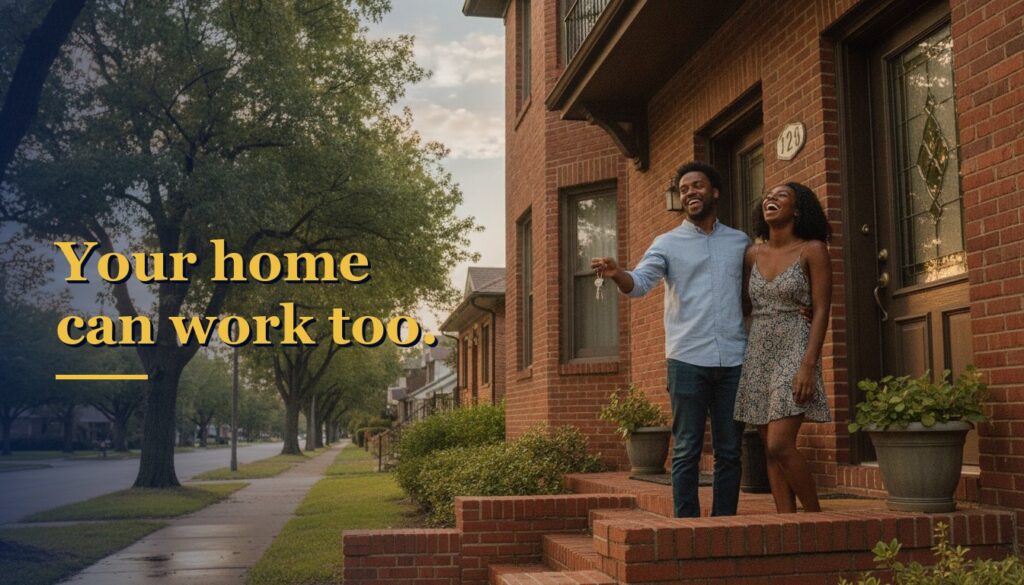
Every month, the biggest check you write goes to a landlord or a mortgage lender. You work hard for that money, and it walks out the door before you get to enjoy anything else. What if your home could carry part of its own weight? That is the idea behind house hacking, and for a lot of families it is the most practical first step into owning real estate.
House hacking simply means living in a property you own while renting out part of it, so the rent from others covers some or all of your housing cost. It is not a trick. It is Owner’s Math applied to the one expense almost everyone has.
Why Your Housing Payment Is the Biggest Leak in Slave Arithmetic
Housing is usually the largest line in the monthly budget. When I walk families through Slave Arithmetic, housing alone often takes 25% to 35% of take-home pay. Add transportation, taxes, debt, insurance and giving, and many households hit 100% before groceries. I break down that math in The 100% Trap.
Most people only have two options for housing: rent, which builds the landlord’s wealth, or buy a home that becomes a pure expense until the day it is sold. House hacking opens a third door. Your home becomes a small business that you happen to live in.
You’re not earning, you’re serving, as long as every dollar goes out and nothing comes back in. House hacking starts reversing the flow.
Four Ways to House Hack
1. The small multifamily
Buy a duplex, triplex or fourplex. Live in one unit and rent the others. This is the classic version, and it can produce the biggest impact on your monthly cost.
2. Rent out rooms
Buy a single-family home with an extra bedroom or two and rent them to roommates. This works well for single buyers or couples without children, and it can often be done with a home you already own.
3. The accessory unit
Some homes have a basement apartment, a garage apartment or a separate cottage, often called an accessory dwelling unit. Where local rules allow it, that unit can be rented while you live in the main house.
4. Live-in, then rent
Live in the home for a period, then move out and keep it as a rental when you buy your next home. Over time, some families repeat this and build a small portfolio one home at a time.
House Hacking by the Numbers
Let me walk through a composite example. These numbers are illustrative only; your market, rates and costs will be different.
Picture Andre and Keisha, currently renting a two-bedroom apartment for $1,900 a month. They buy a duplex for $400,000, live in one side and rent the other for $1,800 a month.
Their monthly ownership cost (illustrative):
- Mortgage principal and interest: $2,450
- Property taxes: $450
- Insurance: $150
- Mortgage insurance: $180
- Total housing payment: $3,230
Now plan honestly for the real costs of owning a rental:
- Vacancy reserve (about 8% of rent): $144
- Repairs and maintenance reserve (about 10% of rent): $180
- Capital expenses reserve for big items like roofs and water heaters: $150
- Total reserves: $474
The math: $3,230 + $474 = $3,704 total monthly cost. Subtract the $1,800 in rent from the other unit: $3,704 − $1,800 = $1,904 net cost to live there.
That is almost exactly their old $1,900 rent. So what changed? Everything:
- Part of that $2,450 mortgage payment is principal, which builds their equity every month instead of disappearing.
- The $474 in reserves is money they are saving, not spending. In a good year, much of it stays in their account.
- Rents tend to rise over time while a fixed-rate principal and interest payment stays the same. If the other side’s rent grows $50 a year, after five years it brings in $250 more each month: $250 × 12 = $3,000 a year of extra margin.
- They have learned how to be landlords with one tenant, on a property they live in and can watch closely.
Same monthly cost as renting. Completely different direction. That is the difference between Slave Arithmetic and Owner’s Math.
How the Financing Usually Works
One reason house hacking is so powerful is that owner-occupied homes often qualify for better loan terms than pure investment properties. Some common options:
- FHA loans can be used for properties with up to four units, as long as the buyer lives in one of them. They are known for lower down payment requirements for borrowers who meet credit guidelines.
- Conventional loans can also be used for owner-occupied multifamily properties, sometimes with low down payment options.
- VA loans, for eligible veterans and service members, may also allow multifamily purchases with an owner-occupancy requirement.
Down payment minimums, credit score requirements, owner-occupancy periods, and whether a lender will count projected rent toward your qualification all change over time and vary by lender. Check the current rules with a licensed lender before you shop. Lower down payments often come with mortgage insurance, so always run the full monthly number, not just the down payment.
What to Know Before You Become a Landlord
House hacking is a real business, and I want you to go in with open eyes.
- You live next to your tenant. Set clear boundaries, use a written lease and handle requests professionally.
- Screen carefully and fairly. Follow fair housing laws and your local landlord-tenant rules. Apply the same written criteria to every applicant.
- Check zoning and permits. Renting rooms or an accessory unit may require approval in some cities.
- Get the right insurance. A standard homeowner’s policy may not cover rental activity. Ask your agent about coverage for an owner-occupied rental.
- Understand the taxes. Rental income is generally taxable, and the rental portion of the property may bring deductions and depreciation. Please talk to a qualified tax professional, and an attorney for your lease and local rules, before you buy.
Do not let this list scare you. Every owner you admire learned these same lessons. The advantage of house hacking is that you learn them on one property you live in, not on a portfolio across town.
Honest questions to ask yourself first
- Am I willing to share walls, a driveway or a yard with someone who is not family for the next few years?
- Do I have cash set aside after closing, so a broken furnace or an empty unit does not become a crisis?
- Would I be comfortable if the rent covered less than I planned for a few months?
- Can I respond to a repair request calmly and quickly, or will I need to hire help from day one?
If you answered yes to most of these, house hacking may be a strong fit. If not, that is fine too. It may mean your first step is building your cash reserves and credit so you are ready when the right property shows up.
The Bigger Picture: Your First Asset
This is Own Assets, the sixth pillar of the F.R.E.E.D.O.M. Framework. An asset puts money in your pocket. For most families, their home is the largest purchase they will ever make, yet it takes money out every month. House hacking makes that purchase start giving back.
And it moves you toward the definition of freedom I teach: Freedom isn’t retirement at 65. It’s passive income greater than active income. (More on that in Freedom Is Not Retirement at 65.) A single house hack will not get you there alone. But it can lower your cost of living, build equity and teach you the skills to buy the next property.
Your Next Move
- Know your true housing number. Add rent or mortgage, insurance, utilities and maintenance. That is the number house hacking needs to beat.
- Study your market. Look up duplexes, triplexes or homes with accessory units in neighborhoods you would actually live in. Note prices and what similar units rent for.
- Talk to a lender. Ask what owner-occupied multifamily options you qualify for today and what down payment and monthly payment would look like.
- Run one deal on paper. Use the example above as a template, including reserves for vacancy, repairs and big-ticket items.
- Check your credit and savings. Stronger credit can mean better terms, and cash reserves help you handle surprises as a new owner.
Is your housing payment building your future?
Take the free Freedom Quiz. In two minutes you’ll have your first move, and a front-row seat to what school never taught: how money multiplies, how passive income is built, and the money rules wealthy families pass down.
One day you will walk past your first house hack and remember when it was just a building you were nervous to buy. It will be the place you stopped only paying for a home and started owning one that pays you back. You can become that owner.
— George M. Howard Jr., “Financial Moses”
Founder, Be Free University
Want Be Free University to show up first in your Google results?




Responses