
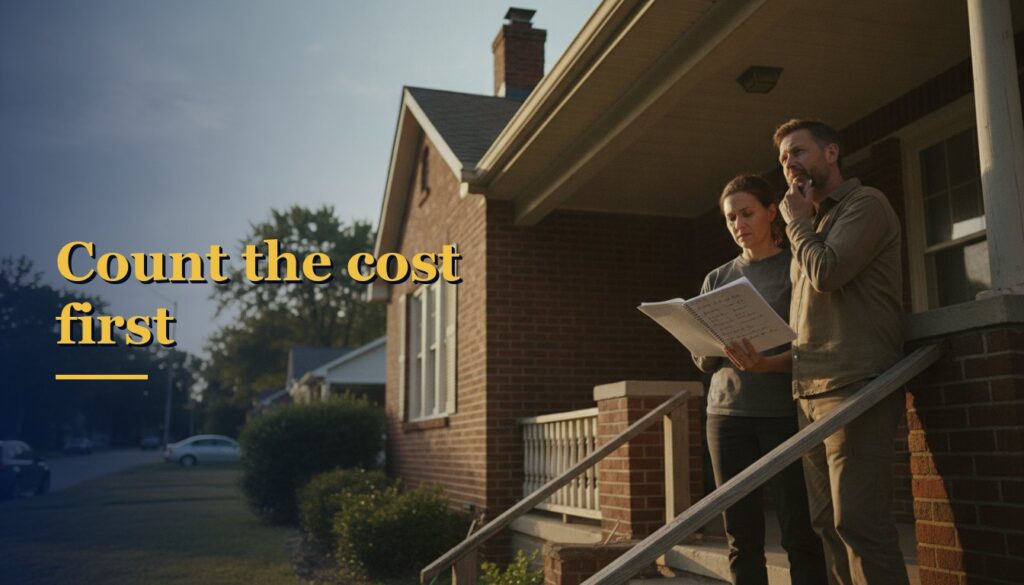
You’ve watched your paycheck climb while your savings barely move, and somewhere along the way you started wondering if a rental house is the thing that finally changes the story. Maybe you’ve scrolled past a listing at night, done some quick math in your head, and thought, “Rent would cover the mortgage. Why am I not doing this?” Before you buy your first rental property, I want to sit down with you and run the numbers the way an owner runs them, because the quick math in your head is exactly where most first-time landlords get hurt.
I love real estate. It sits right in the middle of the Own Assets pillar of the F.R.E.E.D.O.M. Framework, and it’s one of the clearest ways I know for an everyday family to move from earning income to owning income. But a rental is not automatically an asset. Bought wrong, it’s a second job that pays you negative wages. Bought right, it’s a quiet employee that works every day of the month. The difference is in the math you do before you sign.
“For which of you, intending to build a tower, sitteth not down first, and counteth the cost, whether he have sufficient to finish it?” (Luke 14:28, KJV)
Why “Rent Covers the Mortgage” Is the Wrong Test
Here is the trap. You see a house listed at $220,000. Similar homes rent for about $1,950 a month. You call a lender, and the principal and interest on the loan comes out to roughly $1,100. Rent is $850 more than the payment. Looks like a win.
But the mortgage is only one of the bills a rental house sends you. The house also sends you property taxes, insurance, repairs, the months it sits empty between tenants, and the big-ticket replacements that come every few years: the roof, the water heater, the HVAC system. If you hire a property manager, they take a cut too. None of those show up in “rent covers the mortgage.” That’s Slave Arithmetic dressed up as investing: you count the income, ignore most of the costs, and wonder later why you’re writing checks to your own property.
Owner’s Math asks a different question: after every real expense and a reserve for the things that will break, does this property put money in my pocket each month, and how hard is my cash working?
The Five Numbers to Run on Your First Rental Property
You don’t need a finance degree. You need five numbers, and you need to be honest when you fill them in.
- Gross rent. What similar homes in that exact neighborhood actually rent for today. Not the listing agent’s optimistic number. Check current rental listings and ask a local property manager.
- Operating expenses. Taxes, insurance, repairs, vacancy, capital expenses (the big replacements), property management, and any HOA dues or utilities you’ll carry. Get real tax and insurance quotes; don’t guess.
- Net operating income (NOI). Gross rent minus operating expenses, before the mortgage. This tells you what the property earns on its own.
- Cash flow. NOI minus your mortgage payment. This is what actually lands in your account.
- Cash-on-cash return. Your yearly cash flow divided by the total cash you put in (down payment, closing costs and upfront repairs). This tells you how hard your money is working compared to leaving it somewhere else.
Many investors also look at the cap rate, which is annual NOI divided by the purchase price. It lets you compare properties as if you bought them with cash. It’s useful for comparing deals, but cash flow and cash-on-cash are the numbers your household budget will feel.
Worked Numbers: Two Houses, Same Rent, Very Different Results
Let’s run an illustrative example. These numbers are for teaching, not a quote on any real market. Assume both homes rent for $1,950 a month, you put 25% down, and the loan is a 30-year mortgage at 7%. For reserves, I’m using 8% of rent each for vacancy, repairs and capital expenses, plus 10% for management, even if you plan to self-manage. Your time is worth something, and one day you may want to hand it off.
House A: $220,000 purchase price
- Down payment: $55,000. Loan: $165,000. Principal and interest: about $1,098 a month.
- Taxes $250, insurance $120, vacancy $156, repairs $156, capital expenses $156, management $195.
- Total operating expenses: $1,033 a month.
- NOI: $1,950 − $1,033 = $917 a month.
- Cash flow: $917 − $1,098 = negative $181 a month.
That’s the house where “rent covers the mortgage by $850.” In reality, once you reserve for what you know is coming, it costs you about $181 a month. Over a year: $181 × 12 = $2,172 out of your pocket. That’s not an asset feeding you. That’s a mouth you feed.
House B: $160,000 purchase price
- Down payment: $40,000. Loan: $120,000. Principal and interest: about $798 a month.
- Taxes $190, insurance $105, vacancy $156, repairs $156, capital expenses $156, management $195.
- Total operating expenses: $958 a month.
- NOI: $1,950 − $958 = $992 a month, or $11,904 a year. Cap rate: $11,904 ÷ $160,000 = about 7.4%.
- Cash flow: $992 − $798 = $194 a month, or $2,328 a year.
- Cash invested: $40,000 down plus about $8,000 in closing costs and make-ready repairs = $48,000.
- Cash-on-cash return: $2,328 ÷ $48,000 = about 4.9%.
And that’s before two quieter benefits. In year one, your tenant’s rent pays down roughly $1,200 of the loan principal on House B, which builds your equity. Rental property can also come with tax advantages such as depreciation. Those rules have details and limits, so talk with a qualified tax professional about how they apply to your situation before you count on them.
Same rent. One house costs you $2,172 a year. The other pays you $2,328 a year plus equity. The only difference is the price you paid and the honesty of the math.
Where First-Time Landlords Get the Math Wrong
I’ve watched good, hardworking people buy the wrong first property. The mistakes are almost always the same:
- Leaving out reserves. “The house is newly renovated, so I won’t have repairs.” Something will break. Budget for it now or pay for it with panic later.
- Using the seller’s numbers. A listing may show last year’s taxes. In many areas, taxes are reassessed after a sale. Ask the county or your agent to estimate taxes at your purchase price.
- Forgetting landlord insurance is different. A landlord policy is not the same as a homeowner policy, and costs vary a lot by area. Get a real quote before you make an offer.
- Stretching for the down payment. If buying the house drains every dollar you have, the first vacancy or furnace repair turns into credit card debt. Keep separate reserves for the property after closing. Many investors aim for several months of expenses.
- Buying with emotion. You’re not going to live there. Granite countertops are nice. Cash flow is nicer.
Financing matters too. Investment property loans often require a larger down payment and carry a higher rate than a loan on the home you live in. Terms change, so talk with more than one lender and compare current offers before you run your final numbers.
Before You Buy: Is Your House in Order?
A rental property magnifies whatever is already true about your finances. If your monthly cash flow is already stretched, a house full of surprise expenses will stretch it further. That’s why I tell families to look at their own money first. If you’ve ever felt like 100% of your income is spoken for before the month starts, read the 100% trap before you add a second property to that math.
Here’s the owner’s checklist before your first offer:
- Your own household has margin every month, not just on paper.
- You have reserves for your family and separate reserves for the property.
- Your high-interest consumer debt is under control, so a rental isn’t propping up a leaky boat.
- Your credit is strong enough to get a reasonable rate. A fraction of a point on a rate changes cash flow for 30 years.
This is why the F.R.E.E.D.O.M. Framework builds in order. Release Your Flow and Escape Bondage come before Own Assets for a reason. You’re building a foundation that can hold a house.
Your Next Move
You don’t have to buy anything this week. But you can start thinking like an owner this week:
- Pick one neighborhood you understand and pull five current rental listings. Write down what similar homes rent for.
- Run House A and House B yourself using a real listing in that area. Use the same reserve percentages I used above and see what’s left.
- Call one local property manager and ask three questions: what does this type of home rent for, how long does it usually sit empty, and what do repairs typically cost per year?
- Have a pre-approval conversation with a lender about investment property terms, just to learn the down payment and rate you’d actually face.
- Write your “walk away” number: the minimum monthly cash flow, after reserves, that a property must produce before you’ll make an offer.
Is your money ready to own a house?
Take the free Freedom Quiz. In two minutes you’ll have your first move, and a front-row seat to what school never taught: how money multiplies, how passive income is built, and the money rules wealthy families pass down.
From Paying Rent to Collecting It
The goal was never to own a house. The goal is to own your time. One rental with honest numbers won’t make you free on its own, but it teaches you the most important lesson in wealth: money you own can work while you sleep. Freedom isn’t retirement at 65. It’s passive income greater than active income, and a first rental bought right is often the first brick in that wall.
So count the cost. Run the five numbers. Be willing to walk away from ten houses to buy the right one. That’s not fear. That’s what owners do.
You were built to own, not just to serve. Let’s build it one honest number at a time.
— George M. Howard Jr., “Financial Moses”
Founder, Be Free University
Want Be Free University to show up first in your Google results?





Responses