
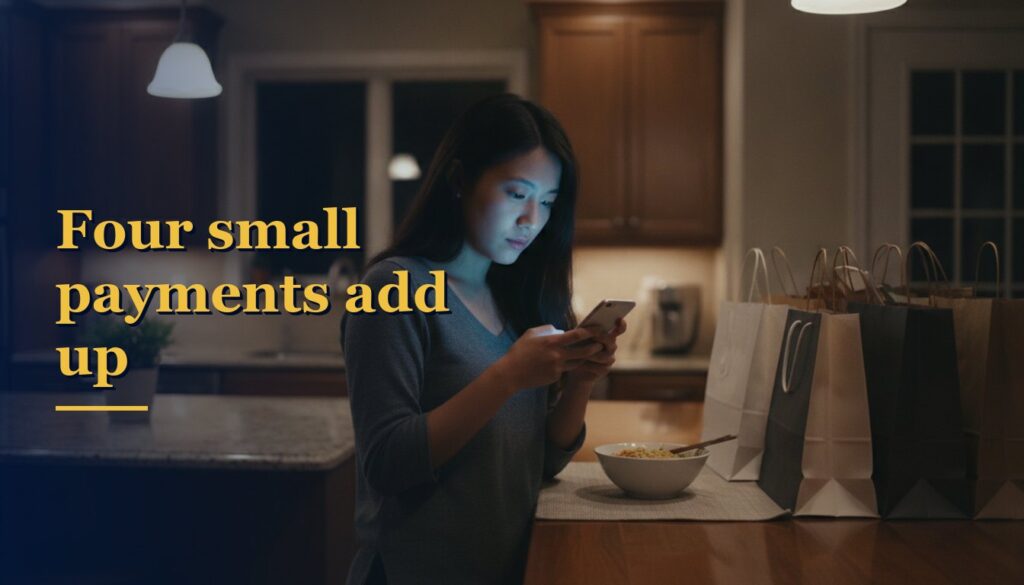
It shows up right at checkout, looking helpful. “Pay in 4 interest-free payments.” No credit card needed, no big hit today, just a small, friendly number. For a busy family trying to keep cash in the account until payday, it can feel like a smart move.
And sometimes it is. But the buy now pay later risks are real, and they’re quieter than the risks of a credit card. The friendly face is the point. The system has learned that people who would never swipe a card for a pair of shoes will happily split them into four.
If you’ve used buy now, pay later, you haven’t done anything wrong. You’re not bad with money. You were offered a tool designed to make spending feel lighter than it is. Let’s look at what’s really happening, with numbers.
How Buy Now, Pay Later Works
The most common version is “pay in 4.” You pay 25% at checkout, then the remaining three payments are automatically charged to your debit card, bank account or credit card, usually every two weeks. Many of these short plans charge no interest if you pay on time.
Some providers also offer longer plans, spread over several months or even years, for bigger purchases. Those often do carry interest, sometimes at rates similar to credit cards. The terms vary widely by provider and by purchase, so the only way to know what you’re agreeing to is to read the specific plan.
So how do these companies make money if you’re not paying interest? Largely from the merchant. Stores pay the provider a fee on each sale, because shoppers using these plans tend to buy more and buy more often. That’s the business model. The store isn’t paying for your convenience. It’s paying for your bigger cart.
The Real Buy Now Pay Later Risks
Interest isn’t the main danger with short BNPL plans. Here’s what is.
1. Stacking
One plan is easy to track. Four or five at once, with payments landing on different dates from different apps, is not. Because each purchase feels small, many people don’t realize how much of their next six weeks is already spoken for.
2. Autopay collisions
BNPL payments pull automatically. If one lands the day before payday and the account is low, you can get hit twice: a late fee from the provider (depending on its terms) and an overdraft or returned-payment fee from your bank.
3. It’s debt that doesn’t look like debt
BNPL doesn’t feel like borrowing. There’s no card, no statement, no balance staring at you. But it is a loan. You got the item now, and you owe money later. Treating it like “not really debt” is exactly how it grows.
4. Credit reporting is changing
Historically, many BNPL plans weren’t reported to the credit bureaus at all. That’s shifting. Some providers now report some or all of their loans, and credit scoring companies have been building BNPL data into newer scoring models. Missed payments can also be sent to collections. Because these practices vary by provider and are still evolving, check your provider’s current terms on credit reporting before you use it, rather than assuming it won’t affect your name.
5. Returns get complicated
Return a BNPL purchase and you’re often dealing with two companies: the store and the lender. Until the refund processes, your scheduled payments may keep coming. That can mean paying for something you’ve already sent back.
The Worked Numbers: How “Small” Payments Stack Up
Let’s run a composite example. Picture a household earning $98,000 a year. Over a couple of weeks leading into a holiday, they use pay-in-4 plans on five purchases:
- Shoes for the kids: $240 → $60 per payment
- A new TV: $600 → $150 per payment
- Flights to visit family: $400 → $100 per payment
- A jacket: $180 → $45 per payment
- Home décor: $320 → $80 per payment
Total purchases: $240 + $600 + $400 + $180 + $320 = $1,740.
Each one felt like a $45 to $150 decision. But once all five are running, the payments due every two weeks add up to $60 + $150 + $100 + $45 + $80 = $435.
That’s $435 pulling from the account every two weeks for six weeks, on top of rent, car, insurance and groceries. If just one of those pulls causes an overdraft, a bank fee can pile on, and the provider may add a late fee of its own. If that happens more than once, the “interest-free” purchase can end up costing noticeably more than paying cash would have.
Now picture that pattern repeating. If this family runs roughly $1,740 through BNPL every other month, that’s about $10,440 a year of purchases, all of them committing future paychecks before those paychecks arrive. That’s Slave Arithmetic: your future income is spent before it’s earned. The math don’t math.
If you’re not sure how much is going out each month, start with Where Does My Money Go Every Month.
What BNPL Is Telling You
Here’s a question worth sitting with: why does the split payment feel necessary? For many good earners, the honest answer is that the account is too thin between paychecks to absorb a $300 purchase. That’s not a character flaw. That’s a sign the system has you squeezed, with almost every dollar already assigned before it lands.
Some families are even using BNPL for groceries and household basics. When that happens, it’s a signal, not a solution. It means there’s no buffer, and the next step is building one, not stacking more plans.
In the F.R.E.E.D.O.M. Framework, this connects to the fourth pillar, Elevate Your Name. Your name is your credit, your reputation and your word. A missed BNPL payment can follow your name further than it used to. And the bigger goal isn’t just protecting your score. It’s getting to a place where you don’t need to borrow for everyday life at all.
Solomon put it plainly thousands of years ago:
“…the borrower is slave to the lender.” (Proverbs 22:7, NIV)
A friendly checkout button doesn’t change that principle. It just makes it easier to forget.
If You Do Use BNPL, Use It Like an Owner
There’s also a mindset shift here. The system trains us to ask, “Can I afford the payment?” An owner asks, “Can I afford the purchase?” Those are two very different questions. The first one keeps you focused on this week. The second one keeps you focused on your freedom. Almost every financial trap, from car loans to credit cards to BNPL, is built on getting you to ask the first question instead of the second.
I’m not saying BNPL is always wrong. Used carefully, an interest-free plan on a purchase you could pay for today in cash can be a reasonable cash-flow tool. Owner’s Math sets some rules:
- The cash test: only use it if the full amount is already sitting in your account. If you couldn’t buy it today, don’t split it.
- One at a time: never run more than one plan at once.
- Set aside the balance: move the remaining payments into a separate account on day one so autopay always has money to pull from.
- No essentials: if you’d need BNPL for groceries or bills, pause and build a buffer instead.
- Read the terms: know the fees, the interest (if any), and whether the provider reports to credit bureaus.
Your Next Move
Take these steps this week:
- Open every BNPL app you’ve used. List every active plan, what’s still owed and the payment dates.
- Add up your next six weeks. Total the payments due. Write that number down. That’s income already spent.
- Stop new plans for 30 days. Let the current ones finish without starting new ones.
- Remove saved BNPL options. Delete the apps or unlink the payment method you use most, to add a little friction.
- Start a buffer account. Even $25 a week toward a small cushion that makes split payments unnecessary.
How much of next month is already spent?
Take the free Freedom Quiz. In two minutes you’ll have your first move, and a front-row seat to what school never taught: how money multiplies, how passive income is built, and the money rules wealthy families pass down.
Here’s who you’re becoming: someone who buys what they want because the money is already there, not because an app made it feel smaller. Someone whose next paycheck arrives free and clear. That’s what it feels like to own your income instead of renting it back.
The friendly face at checkout isn’t your friend. You are. Let’s build that buffer.
— George M. Howard Jr., “Financial Moses”
Founder, Be Free University
Want Be Free University to show up first in your Google results?





Responses