
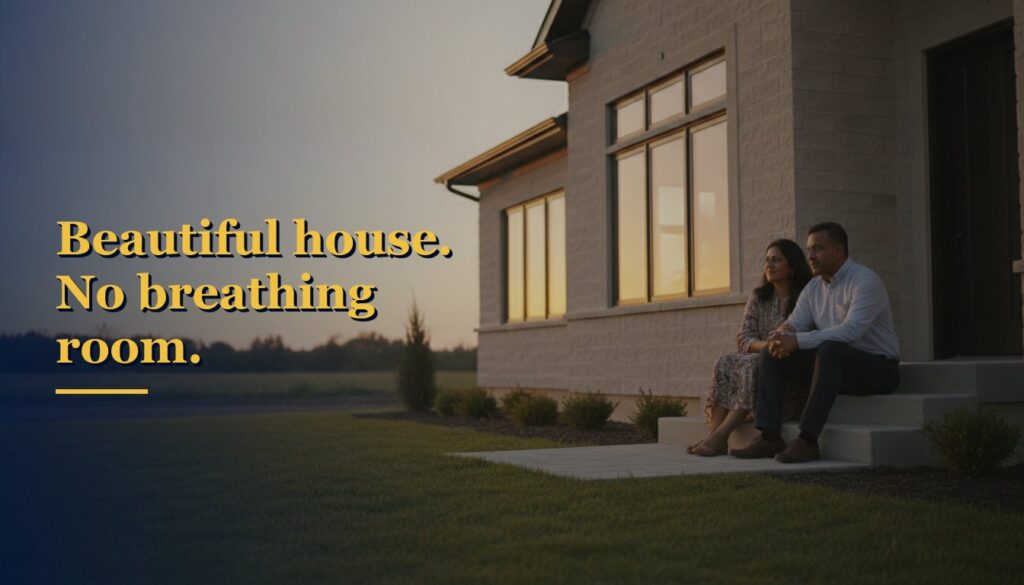
From the street, it looks like you made it. The house is beautiful. The kids have their own rooms. The neighborhood is exactly what you prayed for. But inside, every month feels tight. There’s no real savings, the car needs work, and a surprise bill can knock the whole household off balance.
If that sounds familiar, you may be house poor: earning a solid income but spending so much of it on your home that there’s almost nothing left to live, save or build. It’s one of the most common traps I see among hardworking, high-earning families, and it’s rarely talked about because from the outside, it looks like success. Let’s talk about it honestly.
What Being House Poor Really Means
Being house poor has nothing to do with your character, and nothing to do with how much you earn. It’s a ratio problem. Your home costs eat so much of your income that the rest of your financial life gets squeezed.
The signs are usually easy to spot once you name them:
- You can pay the mortgage, but saving feels impossible.
- Repairs go on a credit card because there’s no cash cushion.
- You’ve said “we can’t afford it” to vacations, giving goals or investing, even with a six-figure income.
- You’d feel real panic if one income dropped for even two months.
- You bought the house, but it feels like the house owns you.
Try this quick stress test. If your household income dropped by a third tomorrow, how many months could you keep paying for the house without borrowing? If the honest answer is “one” or “none,” the house isn’t just a home anymore. It’s a pressure point.
Here’s the thing: lenders often approved you for more than was wise. Approval tells you what the bank is willing to lend. It doesn’t tell you what your family can carry while still building a future.
The House Poor Math: A Worked Example
Let’s run a composite example. Picture a couple earning $120,000 a year together, which is $10,000 a month before taxes. They buy a $550,000 home with 10% down and a 30-year fixed mortgage at 6.5%.
- Loan amount: $550,000 − $55,000 = $495,000
- Principal and interest: about $3,129
- Property taxes (estimate): $550
- Homeowners insurance (estimate): $200
- Private mortgage insurance (estimate): $200
- Total monthly payment: about $4,079
That’s already about 41% of their gross income. A common lending guideline suggests keeping housing costs around 28% of gross income. For this couple, that would be about $2,800 a month.
But we’re not done. Houses need maintenance. A common rule of thumb is to set aside about 1% of the home’s value each year for upkeep. On a $550,000 house, that’s $5,500 a year, or about $458 a month.
True monthly cost of the home: about $4,537.
Now say their take-home pay, after taxes, retirement contributions and benefits, is about $7,400 a month. The house alone takes about 61% of what actually hits their bank account. That leaves about $2,863 for cars, groceries, utilities, childcare, insurance, giving and everything else. You can see how quickly that runs to zero. If you want to see how this piles up across every category, read The 100% Trap.
And over the full 30 years, if they keep the loan to the end, they’ll pay roughly $631,000 in interest on a $495,000 loan. The math don’t math.
How Good Families End Up House Poor
Nobody sets out to buy a cage. It usually happens one reasonable decision at a time.
The pre-approval became the budget
The lender said yes to a number, and the house hunt started at the top of that number instead of well below it.
Only the mortgage got counted
Taxes, insurance, maintenance, higher utilities for a bigger space, furniture to fill it, and sometimes association dues all came later.
The house was bought for a future raise
The plan assumed income would keep climbing. Then a raise was smaller than expected, or a child arrived, or one spouse wanted to step back from work.
The upgrade never stopped
New house, so new furniture. New neighborhood, so new expectations. Each purchase felt small next to the size of the mortgage, and together they added up to thousands. Bigger homes tend to bring bigger everything else.
The house became an identity
This one is deeper. For many of us, the home is proof that we made it. That’s a real feeling. But a home that quietly keeps your family from saving, giving and building is not a reward. It’s a very nice cage.
What the Same Family Could Build Instead
Let’s go back to our couple and change one decision. Say they had bought a $400,000 home instead, with the same 10% down and the same rate.
- Loan amount: $360,000
- Principal and interest: about $2,275, roughly $850 less every month
- Lower taxes, insurance and maintenance on a smaller home push the gap to around $1,000 a month
If they invested that $1,000 a month for 10 years and earned an illustrative 7% a year, they could have roughly $165,000. Returns aren’t guaranteed, but the principle is clear. The difference between a stretching house and a sensible house can be the difference between treading water and building an asset base.
And if they’re already in the $550,000 house? The numbers can still move. Say they rent a finished basement room to a long-term tenant for $800 a month, where local rules allow it. Their true housing cost drops from about $4,537 to about $3,737, and the share of take-home pay falls from roughly 61% to about 50%. Still heavy, but that $800 is the start of real breathing room, and it can go straight into a cash cushion.
This is the R in the F.R.E.E.D.O.M. Framework: Release Your Flow. Cash flow is oxygen. When one bill swallows it, everything else in your financial life runs short of air.
Your Next Move
If you’re already in the house, don’t panic and don’t shame yourself. You have options. Start with these steps this week:
- Calculate your true housing cost. Add principal, interest, taxes, insurance, mortgage insurance, association dues and a maintenance reserve. Divide by your monthly take-home pay. Now you know your real number.
- Check your mortgage insurance. On many conventional loans, you can ask to remove private mortgage insurance once you reach 20% equity based on the original value, and it generally drops off automatically later. Call your servicer and ask what applies to your loan.
- Review your property tax assessment. If your county’s assessed value looks high compared with similar homes, look up how to file an appeal.
- Price your space. Could an extra room, a basement or a parking space bring in income through a long-term roommate or rental, where your local rules and your association allow it?
- Have the honest conversation. Sit down as a household and ask: if this house is keeping us from freedom for the next ten years, is it still the dream? Sometimes the bravest move is a smaller house and a bigger life.
If you’re considering refinancing or selling, run the full numbers first, including closing costs and agent fees, and talk with a trusted lender or financial professional about your specific situation.
A Home Should Be a Blessing, Not a Cage
There is nothing wrong with wanting a beautiful home for your family. Scripture is full of pictures of people dwelling securely in their own homes. But a home is meant to be a place of rest, not a monthly weight that keeps you from ever getting ahead.
Solomon put the order of operations plainly:
“Put your outdoor work in order and get your fields ready; after that, build your house.”
— Proverbs 24:27 (NIV)
Fields first. The things that produce income and stability come first, and the house comes after. When we flip that order and buy the house before the fields are ready, the house ends up taking from the fields instead of resting on them. The good news is that order can be restored, one decision at a time, starting with the numbers you run this week.
You’re not bad with money. You were shown a pre-approval number and told it was a budget. At Be Free University, we teach families to run their own numbers, protect their cash flow, and make the house serve the family instead of the other way around.
Is your house eating your freedom?
Take the free Freedom Quiz. In two minutes you’ll have your first move, and a front-row seat to what school never taught: how money multiplies, how passive income is built, and the money rules wealthy families pass down.
Your family deserves a home with open doors, not bars on the windows. Let’s get you breathing room again.
— George M. Howard Jr., “Financial Moses”
Founder, Be Free University
Want Be Free University to show up first in your Google results?





Responses