
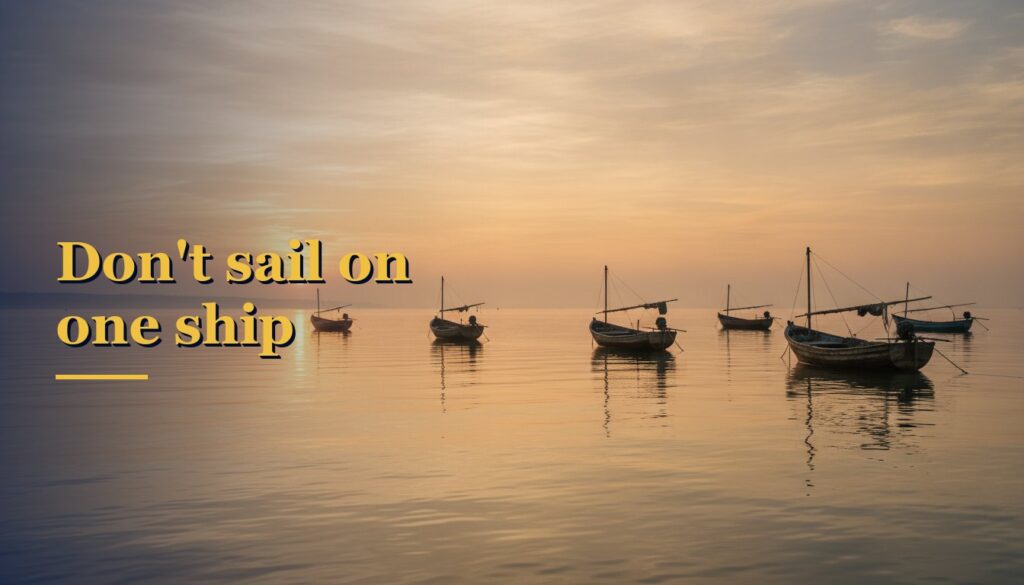
Maybe you’ve felt it on a Sunday night: one paycheck, one employer, one plan, and a quiet fear that if that one thing shakes, everything shakes with it. You work hard and you’re faithful with what you have, but everything you’ve built is resting on a single leg. Three thousand years ago, the wisest king in Israel wrote a sentence about exactly that fear, and it’s the heart of what I call Ecclesiastes 11:2 diversification: spreading what you build so one storm can’t take it all.
“Give a portion to seven, and also to eight; for thou knowest not what evil shall be upon the earth.” (Ecclesiastes 11:2, KJV)
The NIV renders it even more directly: “Invest in seven ventures, yes, in eight; you do not know what disaster may come upon the land.” Solomon isn’t telling you to be afraid. He’s telling you to be wise, because you don’t control the weather, but you do control how you plant.
What Ecclesiastes 11:2 Diversification Really Means
Read the verse in its neighborhood and the picture gets clearer. Ecclesiastes 11 opens with “Cast thy bread upon the waters: for thou shalt find it after many days” (11:1, KJV). Many teachers read that as a picture of sending goods out by sea in trade, trusting that the return will come back in time. Then verse 2 adds the wisdom of spreading those shipments out. Then verse 6 finishes the thought:
“In the morning sow thy seed, and in the evening withhold not thine hand: for thou knowest not whether shall prosper, either this or that, or whether they both shall be alike good.” (Ecclesiastes 11:6, KJV)
Put together, Solomon’s counsel has three parts:
- Send it out. Don’t bury what you have. Put it to work.
- Spread it out. Don’t put everything on one ship. Seven, even eight portions.
- Keep sowing. Morning and evening. You don’t know which seed will prosper, so plant consistently.
This wasn’t abstract theory for Solomon. Scripture describes him running trade by ships, horses, building projects and more (see 1 Kings 10). He wasn’t a one-stream king. He understood that a household, and a kingdom, is safer when it doesn’t depend on one source.
The One-Leg Stool Most Families Sit On
Now look at how most faithful, hardworking families are set up today:
- One primary source of income: a job.
- One major asset: the house they live in.
- One retirement account, often invested the same way year after year without a second look.
- Sometimes, a large amount of their savings in the stock of the company they already work for.
That’s not seven portions. That’s one portion wearing different outfits. If the employer stumbles, the paycheck, the company stock and sometimes even the local housing market can all shake at the same time.
I’m not saying this to scare you. I’m saying it because the system teaches Slave Arithmetic: trade your time for one paycheck, spend nearly all of it, and hope nothing breaks. Owner’s Math asks, “What happens to my family if one thing fails, and how many legs is my household really standing on?”
Worked Numbers: One Ship vs. Seven Ships
Let’s make it concrete with two illustrative examples.
Example 1: Income streams
Picture a household earning $120,000 a year from one job. If that job ends, household income goes from $10,000 a month to $0 overnight.
Now picture the same household after a few years of intentional building:
- Salary: $120,000 a year
- A small side business: $12,000 a year in profit ($1,000 a month)
- One rental property: $4,800 a year in net cash flow ($400 a month)
If the job ends, this family still has $12,000 + $4,800 = $16,800 a year, or $1,400 a month, coming in. That doesn’t replace the salary, but it’s the difference between free fall and a soft landing. It buys time to make wise decisions instead of desperate ones.
Example 2: Investments
Say you have $50,000 invested. If all of it sits in a single company’s stock and that company falls 60%, your $50,000 becomes $20,000. A $30,000 loss.
Now spread that same $50,000 evenly across seven different holdings, about $7,143 each. If one of them falls 60%, you lose about $7,143 × 0.60 = $4,286. Painful, but survivable, and the other six are still standing.
That’s Ecclesiastes 11:2 in a spreadsheet. You don’t know which ship will sink. So don’t put your whole family on one.
A note of wisdom here: diversification lowers the damage any single failure can do, but it doesn’t guarantee profit or eliminate risk. How you spread your investments depends on your goals, timeline and situation. Talk with a qualified financial professional before making investment decisions, and a qualified tax professional about the tax side of any business or property you start.
Seven Portions for an Everyday Family
You don’t need a fortune to start giving portions to seven. You need a plan. Here’s how diversification can look for a Stuck Achiever household over time:
- Your career income, strengthened by skills that make you valuable in more than one place.
- A cash reserve, so an emergency doesn’t force you to sell or borrow at the worst time.
- Retirement accounts, broadly invested rather than concentrated.
- A side business or skill-based income built on something you already know.
- Real estate, when your foundation is ready for it.
- Other investments outside your retirement accounts, spread across different holdings.
- Your children’s future: savings, education and the wisdom to steward it.
You won’t build all seven this year. That’s fine. Solomon’s picture is a lifetime of sowing, morning and evening. This is the Own Assets pillar of the F.R.E.E.D.O.M. Framework in action: moving step by step from one fragile stream to many steady ones.
Don’t Let Wisdom Become an Excuse to Wait
There’s a warning tucked into the same chapter:
“He that observeth the wind shall not sow; and he that regardeth the clouds shall not reap.” (Ecclesiastes 11:4, KJV)
Some people hear “diversify” and freeze. They wait for the perfect conditions, the perfect market, the perfect amount of money. Solomon says the person who waits on perfect weather never plants. Diversification is not a reason to delay. It’s a way to plant with confidence, because you’re not betting everything on one seed.
The opposite mistake is just as real. Some people hear “diversify” and scatter. They chase every opportunity that shows up in their feed, put a little money into things they don’t understand, and end up with seven weak portions instead of seven strong ones. That’s not wisdom either. Each portion should be something you understand, can watch over and can afford to have go wrong without harming your family.
Think of Joseph in Genesis 41. He didn’t guess and he didn’t panic. He saw what was coming, made a plan, and stored up during the good years so Egypt could stand through the lean ones. That’s the spirit of Ecclesiastes 11. Prepare in the season of plenty so the season of famine doesn’t own you.
And remember where all of this is headed. The goal isn’t to collect accounts. It’s to reach the day when what you own produces more than what you earn by the hour. If you want to see that finish line clearly, read why freedom isn’t retirement at 65.
Start where you are. One more stream. One more portion. Then another.
Your Next Move
This week, take an honest inventory of your ships:
- List every source of income your household has today. How many are there, really?
- Check for concentration. Look at your retirement and investment accounts. Is a large share in one company or one type of holding, including your own employer’s stock?
- Ask the storm question: “If my main income stopped for six months, what would we live on?” Write down the honest answer.
- Name your next portion. Pick one new stream or asset you could begin building in the next 90 days, even a small one.
- Read Ecclesiastes 11 in full and ask God for wisdom about where to sow next.
How many legs is your household standing on?
Take the free Freedom Quiz. In two minutes you’ll have your first move, and a front-row seat to what school never taught: how money multiplies, how passive income is built, and the money rules wealthy families pass down.
Sow in the Morning, Sow in the Evening
Solomon wasn’t writing to make you anxious about disaster. He was writing to make you ready for it. A family with seven portions can weather what would sink a family with one, and can keep blessing others while the storm passes.
You were not made to live one paycheck away from panic. You were made to sow widely, steward faithfully and build something that stands in any weather. Cast your bread. Spread your portions. Keep sowing.
— George M. Howard Jr., “Financial Moses”
Founder, Be Free University
Want Be Free University to show up first in your Google results?





Responses